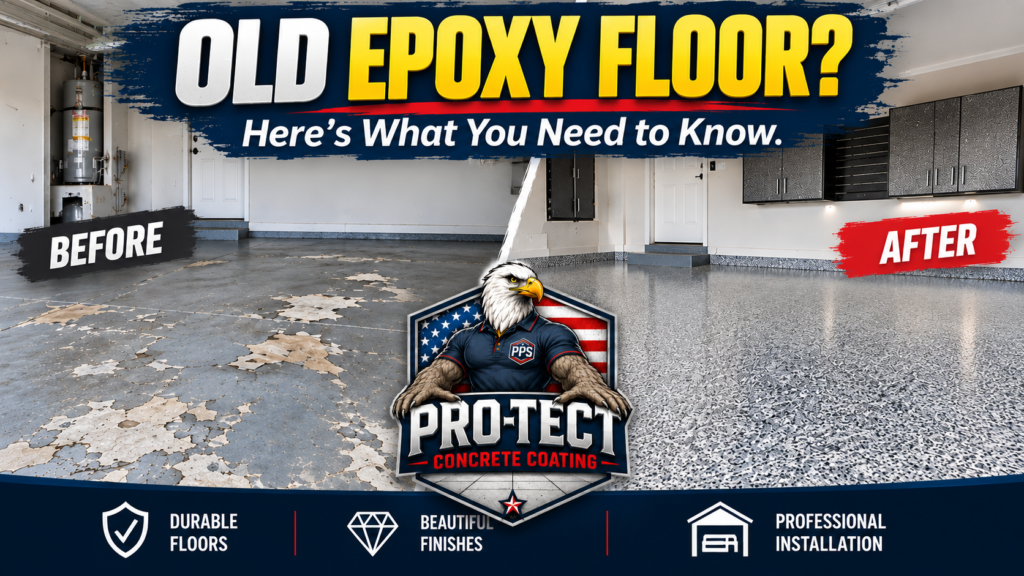
If your garage already has an epoxy floor that’s peeling, fading, worn, or simply outdated, you may be wondering:
Can you put a new garage floor coating over old epoxy?
In some situations, another coating may technically be able to bond to an existing epoxy surface. However, that doesn’t necessarily mean it’s the best way to achieve a durable, professional result.
At Pro-Tect Concrete Coatings, we believe the performance of a garage floor coating starts with what’s underneath it. That’s why proper evaluation and surface preparation are such important parts of the installation process.
If an existing epoxy coating is failing, simply covering it with another coating doesn’t fix the reason it failed in the first place.
Can You Apply a New Garage Floor Coating Over Existing Epoxy?
It depends on the condition of the existing floor, the products involved, and how well the original coating is bonded to the concrete.
But there’s an important issue to consider.
When a new coating is applied directly over an old epoxy floor, the new system is relying on the old coating’s bond to the concrete.
Even if the new coating bonds extremely well to the epoxy underneath it, the entire system can still fail if that original epoxy loses adhesion.
Think of it this way:
Your new floor is only as reliable as the surface it’s attached to.
That’s one reason professional surface preparation is so important.
Why Is My Old Epoxy Garage Floor Peeling?
There isn’t one single reason an epoxy garage floor may begin peeling or delaminating.
Possible contributing factors can include:
- Inadequate concrete preparation
- Moisture vapor coming through the concrete
- Contamination from oil, grease, or other substances
- Poor adhesion to the concrete
- Improper installation
- Concrete-related issues
- Age and normal wear
- Product or application problems
The visible peeling may only be part of the problem.
Before installing another coating, it’s important to evaluate the existing surface and the condition of the concrete underneath.
Should Old Epoxy Be Removed Before Installing a New Garage Floor Coating?
For many garage floor restoration projects, removing the existing coating allows the installer to properly evaluate and prepare the concrete substrate instead of relying on an unknown existing coating.
This is particularly important when the old epoxy is already:
Peeling, flaking, bubbling, delaminating, damaged, or poorly bonded.
Installing a premium coating system over a failing surface doesn’t make the underlying problem disappear.
Removing the old material can expose the actual concrete and allow appropriate surface preparation before the new coating system is installed.
Why Concrete Preparation Matters
One of the most important parts of a professional garage floor coating isn’t the part homeowners see when the project is finished.
It’s the surface preparation underneath the coating.
At Pro-Tect Concrete Coatings, proper concrete preparation is a critical part of our installation process.
We use professional diamond-grinding equipment to mechanically prepare the concrete surface.
Diamond grinding helps remove surface contaminants and creates the appropriate concrete profile for the coating system being installed.
Rather than relying on a coating to stick to an unknown surface, professional preparation allows the new system to establish its bond with properly prepared concrete.
What Happens After the Old Epoxy Is Removed?
Once the existing coating has been removed, the underlying concrete can be evaluated.
Depending on the condition of the floor, preparation may include:
- Removal of the existing coating
- Diamond grinding of the concrete
- Evaluation of cracks and damaged areas
- Appropriate repairs when needed
- Surface cleaning and preparation
- Installation of the coating system
- Decorative full-flake broadcast
- Application of the protective topcoat
Every garage floor is different, which is why evaluating the actual concrete is important before determining the appropriate installation process.
What About Moisture Under an Epoxy Garage Floor?
Moisture can be an important consideration when evaluating a failing concrete coating.
Concrete is porous, and moisture vapor can move through a concrete slab under certain conditions. If moisture is contributing to an adhesion problem, simply installing another coating over the existing epoxy may leave that underlying condition unaddressed.
At Pro-Tect Concrete Coatings, we take moisture conditions seriously.
Our flooring systems can incorporate a moisture-mitigating epoxy base coat as part of the installation system when appropriate for the project.
The goal isn’t simply to make an old floor look new again.
It’s to properly prepare the substrate and install a complete system designed for the conditions of the floor.
Can Polyurea Be Installed Over an Old Epoxy Floor?
The more useful question isn’t simply whether polyurea can adhere to epoxy.
It’s:
What should the new coating system be bonded to for the best possible installation?
If the existing epoxy has questionable adhesion, installing polyurea over it means the new coating is still dependent on that old epoxy staying attached to the concrete.
That’s why evaluating the existing coating and substrate is so important.
At Pro-Tect, we specialize in professional polyurea concrete coating systems rather than traditional epoxy garage floors.
The specific preparation and installation approach depends on the condition of your existing floor.
Can a Peeling Epoxy Garage Floor Be Fixed?
A peeling epoxy garage floor doesn’t necessarily mean you’re stuck with an ugly floor.
In many cases, an existing coating can be removed and the concrete professionally prepared for a new coating system.
However, we’d rather determine why the existing floor is failing than simply hide the problem underneath another layer of material.
Peeling, bubbling, cracking, discoloration, and delamination can indicate different conditions.
A professional evaluation helps determine what you’re actually dealing with.
What If Only a Small Area of Epoxy Is Peeling?
Even when the majority of the garage looks fine, localized peeling deserves attention.
The question is whether the problem is truly isolated or whether other areas of the existing coating also have weak adhesion.
The visible condition of the floor doesn’t always tell the entire story.
That’s why we recommend evaluating the existing coating before deciding whether removal, repair, or another preparation method is appropriate.
Old Epoxy vs. a New Professional Garage Floor Coating
If your old epoxy floor has seen better days, replacing it gives you an opportunity to do more than simply change the color.
A professionally installed garage floor coating can provide:
- A clean, finished appearance
- A durable surface designed for garage use
- A full-flake decorative finish
- Easier routine cleaning and maintenance
- Multiple color options
- A professionally prepared concrete substrate
- A coating system selected for the floor’s conditions
The transformation can be dramatic, particularly when replacing a worn, peeling, or outdated epoxy floor.
Don’t Just Cover Up a Failing Garage Floor
If your existing epoxy garage floor is peeling or failing, applying another coating over it may simply cover the symptoms without addressing what’s happening underneath.
The better approach is to determine the condition of the existing coating and concrete first.
At Pro-Tect Concrete Coatings, we specialize in professionally installed garage floor coating systems throughout Los Angeles and the San Fernando Valley.
Our process emphasizes proper concrete preparation, including professional diamond grinding, repairs when needed, and premium coating systems designed to provide a durable, attractive finished floor.
Already have an epoxy garage floor?
We’ll evaluate the existing surface and help determine the appropriate approach for transforming it.
Get a Free Garage Floor Estimate
If your existing epoxy garage floor is peeling, damaged, faded, or simply ready for an upgrade, contact Pro-Tect Concrete Coatings for a free estimate.
Pro-Tect Concrete Coatings
Los Angeles & San Fernando Valley
Call: 747-333-5901
CSLB License #1156862 · Class B, Class C61/D12
Licensed · Bonded · Insured
Get your free estimate today.