When you’re choosing a garage floor coating, it’s easy to focus on the part you’ll actually see: the color, decorative flakes, gloss level, and finished appearance.
But one of the most important parts of a professional garage floor coating happens before the coating is ever applied.
It’s the preparation of the concrete.
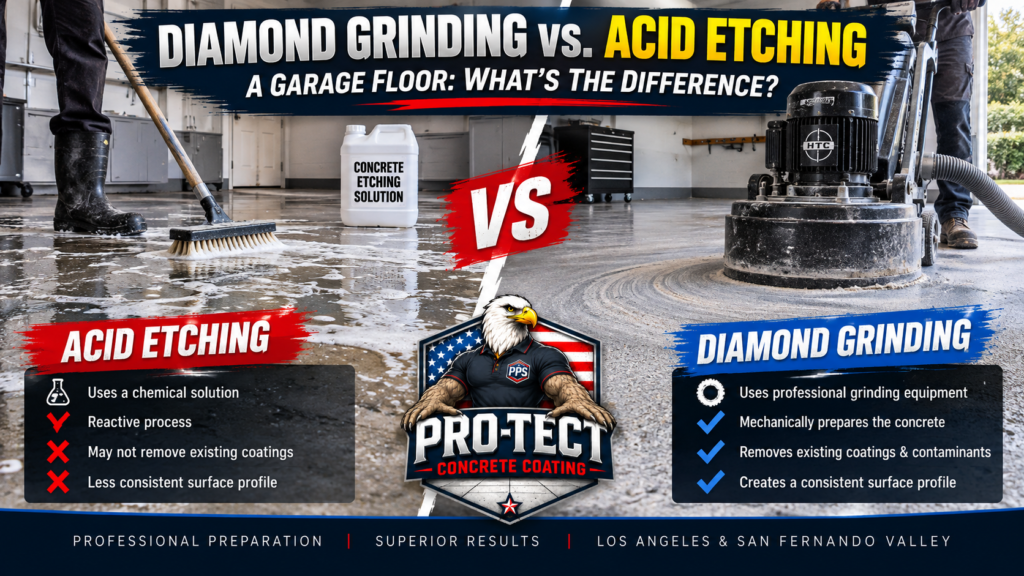
Two methods you’ll commonly hear about are diamond grinding and acid etching. Both are intended to prepare concrete, but they accomplish that in very different ways.
At Pro-Tect Concrete Coatings, we use professional diamond grinding as part of our concrete preparation process. Here’s why surface preparation matters and how diamond grinding compares with acid etching.
Why Does a Garage Floor Need to Be Prepared Before Coating?
Concrete may look clean and solid while still having conditions that can interfere with a coating’s ability to bond properly.
The surface can contain contaminants, previous coatings, sealers, dirt, oils, or other materials. The concrete also needs an appropriate surface profile for the coating system being installed.
That’s why applying a premium coating directly to an improperly prepared garage floor can be a problem.
A coating system is only as good as the surface it’s bonded to.
Proper preparation helps create a suitable surface for the coating system and gives the installer an opportunity to evaluate the condition of the concrete before installation begins.
What Is Acid Etching?
Acid etching is a chemical method of preparing concrete.
An acidic solution is applied to the concrete, where it reacts with components of the cement paste at the surface. The floor is then treated according to the product and preparation procedure being used, which can include thorough rinsing and appropriate handling of residue.
The chemical reaction can alter the surface texture of the concrete.
Acid etching has historically been used for concrete preparation because it can be less equipment-intensive than mechanical grinding.
However, it has limitations.
What Is Diamond Grinding?
Diamond grinding is a mechanical concrete preparation method.
Professional grinding machines equipped with diamond tooling are moved across the floor to mechanically abrade the concrete surface.
Rather than relying on a chemical reaction, the equipment physically prepares the concrete.
Depending on the tooling, equipment, existing surface, and project requirements, mechanical grinding can help remove surface material such as:
- Existing coatings
- Certain surface contaminants
- Sealers and residues
- Weak surface material
- Paint or previous flooring materials
The objective isn’t simply to make the concrete look rough.
The goal is to create an appropriate and consistent concrete surface profile for the coating system being installed.
Diamond Grinding vs. Acid Etching: What’s the Main Difference?
The biggest difference is straightforward:
Acid etching chemically reacts with the concrete surface.
Diamond grinding mechanically prepares the concrete surface.
That difference affects how much control an installer has over the preparation process.
With professional diamond grinding, the contractor can select equipment and tooling based on the actual condition of the floor and physically work across the surface.
Acid etching relies on a chemical reaction, and the results can be affected by the condition and composition of the concrete as well as contamination and previous treatments.
Can Acid Etching Remove an Existing Garage Floor Coating?
This is an important consideration for homeowners who already have paint, epoxy, or another coating on their garage floor.
Acid etching isn’t the same thing as mechanically removing an existing coating.
If an old coating needs to be removed, mechanical preparation is often required to expose and prepare the underlying concrete.
This is particularly relevant when an existing garage floor is:
- Peeling
- Flaking
- Delaminating
- Worn
- Previously painted
- Covered with an older coating system
Simply preparing the surface of a failing coating doesn’t necessarily address the condition of the concrete underneath it.
Why Does the Concrete Surface Profile Matter?
A concrete floor can feel rough to your hand without necessarily having the appropriate profile for a particular coating system.
Professional concrete preparation is about more than making the floor “rough.”
The installer needs to prepare the substrate according to the requirements of the flooring system.
A consistent surface profile helps provide the coating with a properly prepared substrate to bond to.
This is one reason professional equipment and installation procedures matter.
The Part of Your Garage Floor You’ll Never See May Be the Most Important
Once your garage floor is finished, you won’t see the preparation work anymore.
You’ll see the decorative flakes.
You’ll see the finished topcoat.
You’ll see a clean, transformed garage.
But underneath that finished surface is the concrete that was prepared before installation.
That’s why we believe homeowners should ask contractors about more than just what coating they use.
Ask them:
How are you preparing my concrete?
The answer can tell you a lot about the installation you’re purchasing.
Why Pro-Tect Uses Diamond Grinding
At Pro-Tect Concrete Coatings, professional diamond grinding is a critical part of our garage floor preparation process.
We want to mechanically prepare the concrete before installing our coating system.
Diamond grinding gives our installers the ability to work directly with the substrate and prepare the floor based on its actual condition.
It can also expose conditions that may not have been as obvious beforehand, including certain cracks, previous repairs, damaged areas, and remnants of old coatings.
The goal isn’t to complete the preparation as quickly or cheaply as possible.
The goal is to give the coating system the properly prepared foundation it needs.
Does Diamond Grinding Remove Oil and Contamination?
This requires a little nuance.
Grinding can remove contaminated surface material, but not every contamination problem can be solved simply by grinding the floor.
Oil, for example, may penetrate into porous concrete.
The condition and depth of contamination need to be evaluated before determining the appropriate preparation procedure.
That’s another reason professional inspection matters.
A contractor shouldn’t assume every garage floor is identical.
What About Concrete Dust From Grinding?
Professional concrete grinding generates dust, which is why appropriate dust-control equipment is an important part of the process.
Professional grinding setups commonly use industrial vacuum equipment designed to collect dust as the concrete is mechanically prepared.
The exact amount of airborne or residual dust depends on the equipment, floor condition, containment, and work procedures.
After grinding, the surface still needs to be properly prepared and cleaned before the coating system is installed.
Does Diamond Grinding Damage the Concrete?
When performed correctly with appropriate professional equipment and tooling, diamond grinding is intended to prepare the surface of the concrete, not unnecessarily damage a sound garage slab.
The amount of material removed depends on the equipment, tooling, floor condition, and preparation requirements.
That’s another reason experience matters.
More aggressive isn’t automatically better.
The objective is the correct surface preparation for the coating system and substrate.
What Happens If a Garage Floor Isn’t Prepared Properly?
Poor surface preparation can contribute to coating problems.
Potential issues can include:
- Poor adhesion
- Peeling
- Delamination
- Localized coating failure
- Problems around contaminated areas
However, preparation isn’t the only factor that can affect a coating.
Moisture conditions, concrete quality, existing contamination, product selection, application procedures, substrate movement, and other factors can also influence performance.
That’s why we look at the garage floor as an entire system rather than assuming one installation step determines everything.
Is Acid Etching Always Bad?
No.
It’s easy for contractors to turn this comparison into:
Diamond grinding = good. Acid etching = bad.
That’s too simplistic.
Acid etching has been used as a concrete preparation method in various applications, and whether a particular preparation method is appropriate depends on the substrate, coating manufacturer’s requirements, environmental considerations, and project conditions.
But for the professional garage floor coating systems we install, Pro-Tect chooses mechanical diamond grinding because it gives us greater control over preparing the concrete substrate.
We would rather explain why we use our process than claim that every other preparation method automatically results in failure.
Can You Coat a Garage Floor Without Grinding It?
There isn’t one universal answer for every coating product and every concrete floor.
Different manufacturers and flooring systems can specify different preparation methods.
For the systems installed by Pro-Tect, however, professional mechanical preparation is an important part of our installation process.
We don’t want to simply clean the garage floor and start applying coating.
We want to evaluate and properly prepare the concrete first.
What If the Garage Floor Already Has Epoxy?
An existing epoxy or painted floor requires additional evaluation.
If the old coating is poorly bonded, peeling, or failing, installing a new coating directly over it can create a significant problem.
Even if the new material bonds perfectly to the old coating, the entire system still depends on that old coating remaining attached to the concrete.
When necessary, mechanical grinding can be used as part of the process of removing existing material and preparing the underlying substrate for the new system.
This is why we recommend having an old epoxy floor evaluated before deciding simply to coat over it.
What About Cracks in the Concrete?
Grinding can help expose the actual condition of the concrete, but it doesn’t magically eliminate structural movement or guarantee that cracks will never return.
Cracks and damaged areas should be evaluated and repaired appropriately as part of the preparation process when required.
It’s important for homeowners to understand that a coating system does not prevent the underlying concrete from moving, settling, or developing future cracks.
Professional preparation helps us start with the best substrate conditions reasonably possible.
Surface Preparation vs. Coating Brand
Homeowners often spend most of their time comparing coating names:
Epoxy vs. polyurea.
Polyurea vs. polyaspartic.
Brand A vs. Brand B.
Those are valid questions, but they aren’t the entire story.
You can purchase premium coating materials and still have problems if the concrete underneath them isn’t appropriately prepared.
That’s why we’d recommend asking any garage floor contractor several questions:
How will you prepare my concrete?
Do you mechanically grind the floor?
How do you handle an existing coating?
What happens if you discover cracks or damaged concrete?
How do you address potential moisture conditions?
The answers help you understand the entire installation process, rather than simply the name printed on the coating container.
A Beautiful Garage Floor Starts With Proper Preparation
The finished floor gets all the attention.
But the transformation starts before the decorative flakes ever come out.
At Pro-Tect Concrete Coatings, we emphasize professional concrete preparation because we’re installing a complete flooring system—not simply applying a coating over whatever happens to be on the garage floor.
Our process includes professional diamond grinding, evaluation of the concrete, appropriate repairs when required, and installation of a premium coating system designed for residential garage use.
The preparation eventually disappears underneath your new floor.
But that doesn’t make it any less important.
Professional Garage Floor Coatings in Los Angeles
If you’re considering upgrading your garage floor, ask about what’s going underneath the finished coating—not just what the finished floor will look like.
Pro-Tect Concrete Coatings installs professional garage floor coating systems throughout Los Angeles and the San Fernando Valley.
Whether you’re starting with bare concrete, an older painted floor, or a failing existing coating, we’ll evaluate the condition of your garage and determine the appropriate preparation process before installation.
Pro-Tect Concrete Coatings
Los Angeles & San Fernando Valley
747-333-5901
CSLB License #1156862 · Class B, Class C61/D12
Licensed · Bonded · Insured
Get your free estimate today.