You installed an epoxy garage floor expecting a clean, attractive finish—but over time, parts of the floor have started developing a yellow or amber tint.
What happened?
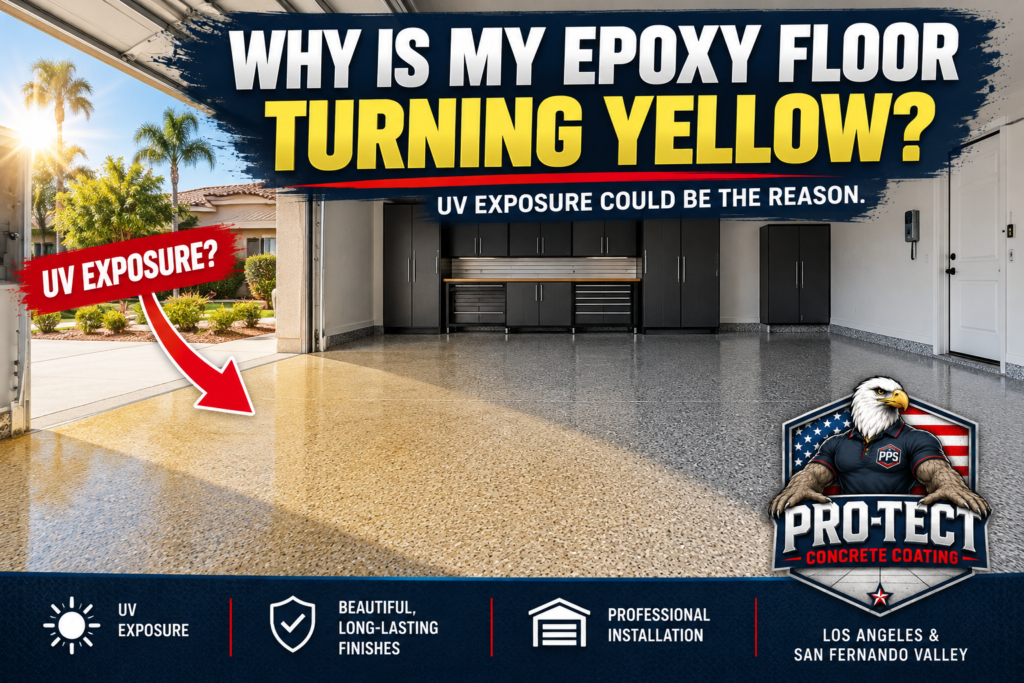
Yellowing is a common concern with certain epoxy flooring systems, particularly when they’re exposed to ultraviolet (UV) light. The discoloration can be especially noticeable near garage doors, windows, and other areas that receive sunlight.
If your epoxy garage floor is turning yellow, here’s what may be causing it—and what you should know before replacing or recoating the floor.
Why Does Epoxy Turn Yellow?
One of the primary reasons certain epoxy coatings discolor is UV exposure.
Some epoxy resins are not inherently UV stable. As the coating is repeatedly exposed to ultraviolet radiation, chemical changes can occur within the material that alter its appearance.
This discoloration is often referred to as ambering or yellowing.
The change may happen gradually, which means homeowners don’t always notice it immediately.
Then one day you move a cabinet, storage bin, floor mat, or other object and discover that the protected area underneath looks noticeably different from the surrounding floor.
Why Is the Epoxy Near My Garage Door More Yellow?
This is one of the biggest clues that UV exposure may be contributing to the problem.
When your garage door is open, sunlight reaches the portion of the floor closest to the entrance.
Areas farther inside the garage may receive significantly less direct UV exposure.
Over time, you may notice a difference between the exposed and protected portions of the floor.
The result can be an uneven appearance where one section looks yellow, amber, faded, or simply different from the rest of the garage.
For homeowners in Los Angeles and Southern California, where garages can receive substantial sunlight throughout the year, UV performance is an important consideration when selecting a flooring system.
Does All Epoxy Turn Yellow?
Not necessarily, and this is where it’s important not to oversimplify the issue.
There are many different epoxy formulations and complete flooring systems. Their resistance to discoloration can vary based on the resin chemistry, additives, pigmentation, topcoat, installation, and environmental exposure.
A properly designed flooring system may also use a more UV-stable protective topcoat over underlying layers.
So rather than saying that every epoxy floor will turn yellow, it’s more accurate to say that certain epoxy materials can be susceptible to UV-related discoloration.
That’s one reason homeowners should evaluate the entire coating system, not simply whether a contractor calls the floor “epoxy,” “polyurea,” or “polyaspartic.”
Is Yellowing the Same as the Coating Failing?
No.
This distinction is important.
A garage floor can become discolored while remaining bonded to the concrete.
Yellowing is primarily an appearance issue, whereas coating failure can involve problems such as:
- Peeling
- Delamination
- Bubbling or blistering
- Loss of adhesion
- Excessive wear
- Chipping or other damage
If your floor has changed color but remains firmly attached, you’re dealing with a different problem than a floor that’s actively peeling away from the concrete.
However, if you’re seeing yellowing along with peeling, bubbling, or delamination, the entire floor should be evaluated before deciding what to do next.
Can Yellow Epoxy Be Cleaned?
If the discoloration is occurring within the coating itself because of UV-related chemical changes, normal cleaning generally won’t restore the original color.
That’s different from a floor that simply looks yellow because of:
- Dirt
- Oil
- Tire residue
- Chemical contamination
- Cleaning-product residue
- Other surface staining
Before assuming the epoxy itself has yellowed, it’s worth determining whether the discoloration is actually on the surface or within the coating.
If cleaning doesn’t change the appearance and the discoloration follows areas of UV exposure, the coating itself may have changed color.
Can You Fix a Yellowing Epoxy Garage Floor?
The appropriate solution depends on the condition of the existing coating.
If you’re unhappy with an older epoxy floor, a professional contractor should evaluate:
The existing coating, its adhesion, the concrete underneath, signs of moisture or damage, and the condition of the overall flooring system.
Simply putting another coating over an existing floor isn’t always the best answer.
If the underlying epoxy has poor adhesion or other problems, covering it doesn’t eliminate those issues.
Should You Coat Over Yellow Epoxy?
Technically, certain coatings may be capable of bonding to properly prepared existing coatings.
But there’s an important question:
How well is the existing epoxy bonded to the concrete?
If a new coating is installed over old epoxy, the new floor is still dependent on the old epoxy remaining attached.
If that original layer eventually delaminates, everything installed over it can come with it.
That’s why Pro-Tect evaluates the existing floor rather than automatically recommending that it simply be covered.
Should Old Epoxy Be Removed?
If an existing epoxy floor is deteriorated, poorly bonded, peeling, or otherwise unsuitable as a substrate, removal may be necessary before installing a new flooring system.
Removing the existing material also gives the installer access to the actual concrete.
That’s important because surface preparation is one of the most critical parts of a professional garage floor installation.
At Pro-Tect Concrete Coatings, we use professional diamond-grinding equipment to mechanically prepare concrete for our coating systems.
The beautiful finished floor is what you see.
The preparation underneath it is what you don’t see—and it matters.
What About Polyurea and Polyaspartic Garage Floor Coatings?
This is where terminology can become confusing.
Professional garage flooring systems may contain multiple layers and different coating chemistries rather than one material from bottom to top.
Polyurea and polyaspartic materials are commonly used in professional concrete coating systems, and certain formulations can offer excellent UV stability.
At Pro-Tect, we install premium coating systems designed as a complete system, taking into consideration the substrate, preparation, base coat, decorative flake broadcast, and protective topcoat.
That’s more important than selecting a floor based on one product name alone.
Why the Topcoat Matters
The topcoat is the layer of your garage floor that’s directly exposed to:
- Sunlight
- Vehicle traffic
- Dirt and debris
- Cleaning
- Spills
- Everyday garage use
Its properties can therefore have a major impact on how the finished floor performs and maintains its appearance.
When comparing garage floor coating contractors, don’t just ask:
“Do you use epoxy or polyurea?”
Ask about the entire flooring system:
What preparation is performed? What base coat is used? What decorative layer is installed? What type of topcoat protects the finished floor?
Those questions tell you considerably more about what you’re actually purchasing.
Can You Prevent Garage Floor Discoloration?
No garage floor should be marketed as indestructible, and every coating system has limitations.
However, selecting materials appropriate for the environment can help reduce problems associated with UV exposure and everyday garage use.
Proper installation also matters.
A premium coating cannot compensate for inadequate concrete preparation, just as excellent preparation cannot change the inherent properties of a poorly selected coating.
You need the right preparation and the right coating system working together.
Is It Time to Replace Your Old Epoxy Floor?
A little discoloration doesn’t necessarily mean you need a new garage floor.
But if your existing epoxy is:
Yellowing, badly faded, peeling, bubbling, worn, damaged, or simply no longer giving your garage the appearance you want, it may be worth having the floor professionally evaluated.
Sometimes the problem is cosmetic.
Sometimes there’s a problem underneath.
Knowing the difference is important before deciding how to fix it.
Upgrade Your Old Epoxy Garage Floor
If your epoxy garage floor has turned yellow, faded, started peeling, or simply looks outdated, Pro-Tect Concrete Coatings can evaluate the existing floor and determine the appropriate approach for your garage.
We install professional garage floor coating systems throughout Los Angeles and the San Fernando Valley, with an emphasis on proper concrete preparation, professional diamond grinding, premium materials, and beautiful full-flake finishes.
Don’t just cover up an old floor.
Find out what’s happening underneath it first.
Pro-Tect Concrete Coatings
Los Angeles & San Fernando Valley
747-333-5901
CSLB License #1156862 · Class B, Class C61/D12
Licensed · Bonded · Insured
Get your free estimate today.